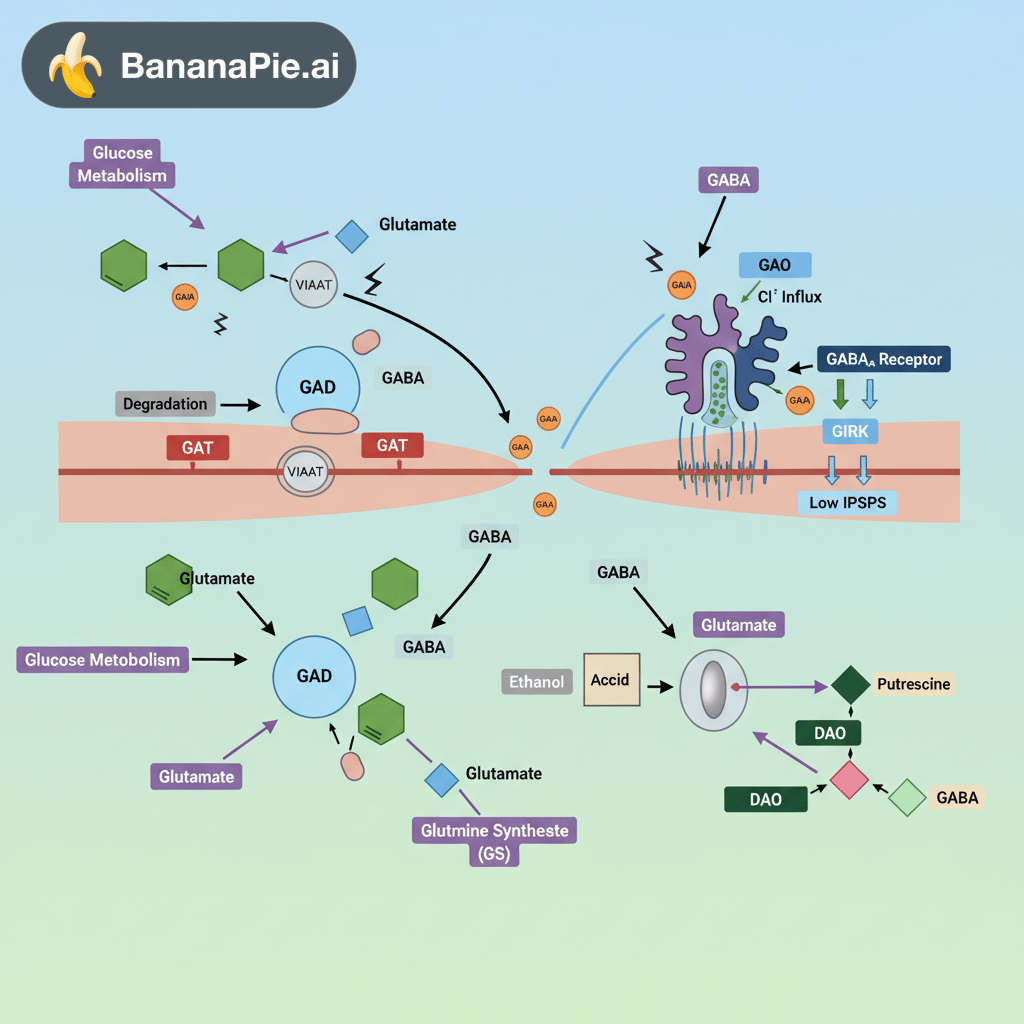
你是一名专业的科研绘图设计师,请仔细阅读我提供的文献信息,深度理解其传达的科学含义,并参考我上传的图片,生成可用于科研发表的AI绘图提示词。风格:BioRender风格。图片描述内容:In presynaptic neurons, glutamate is converted into GABA by GAD. Glutamate can come from either glucose metabolism or conversion of glutamine taken up from the synaptic cleft. In astrocytes, GABA can also be synthesized through the GAD pathway, with glutamate sources including glucose metabolism and direct uptake from the synaptic cleft. Simultaneously, glutamate can be converted into glutamine under the catalysis of glutamine synthetase (GS), maintaining the relative balance of glutamine in the synaptic cleft. besides, ethanol can be converted into acetic acid, which subsequently generates GABA. GABA is released directly into the synaptic cleft, while another portion is transported into vesicles by VIAAT, awaiting release into the cleft via nerve impulses. At the postsynaptic membrane, GABA binds to GABAA receptors, inducing Cl⁻ influx; binding to GABAB receptors, generating low IPSPs by activating GIRK. GABA in the synaptic cleft can be reabsorbed back into the presynaptic membrane via GAT, with some re-entering vesicles and others transported to mitochondria for degradation. During the degradation process, puterscine can be produced, which is then metabolized by DAO and PAO to regenerate GABA.

@Jingyang Hu
Prompt
你是一名专业的科研绘图设计师,请仔细阅读我提供的文献信息,深度理解其传达的科学含义,并参考我上传的图片,生成可用于科研发表的AI绘图提示词。风格:BioRender风格。图片描述内容:In presynaptic neurons, glutamate is converted into GABA by GAD. Glutamate can come from either glucose metabolism or conversion of glutamine taken up from the synaptic cleft. In astrocytes, GABA can also be synthesized through the GAD pathway, with glutamate sources including glucose metabolism and direct uptake from the synaptic cleft. Simultaneously, glutamate can be converted into glutamine under the catalysis of glutamine synthetase (GS), maintaining the relative balance of glutamine in the synaptic cleft. besides, ethanol can be converted into acetic acid, which subsequently generates GABA. GABA is released directly into the synaptic cleft, while another portion is transported into vesicles by VIAAT, awaiting release into the cleft via nerve impulses. At the postsynaptic membrane, GABA binds to GABAA receptors, inducing Cl⁻ influx; binding to GABAB receptors, generating low IPSPs by activating GIRK. GABA in the synaptic cleft can be reabsorbed back into the presynaptic membrane via GAT, with some re-entering vesicles and others transported to mitochondria for degradation. During the degradation process, puterscine can be produced, which is then metabolized by DAO and PAO to regenerate GABA.
Model
NANO-BANANA
Type
Image
Likes
0
Aspect Ratio
1/1