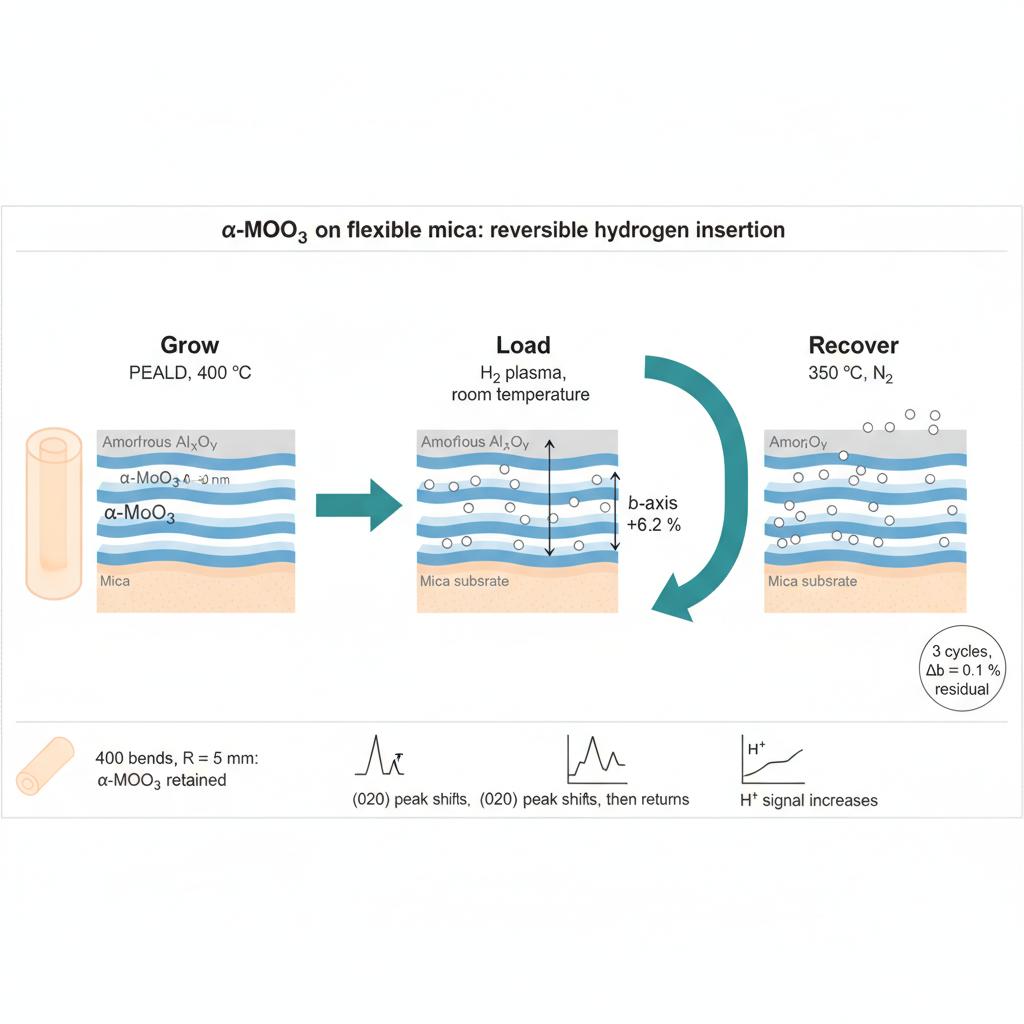
Create a clean, flat-style scientific graphical abstract for a materials-science journal (Elsevier style), landscape format with a 2.5:1 aspect ratio (e.g. 3000 × 1200 px), white background, minimal text, readable when reduced to 13 cm width. Vector-like look, soft gradients only, no photorealism, no 3D clutter. TITLE STRIP (top, small): "α-MoO₃ on flexible mica: reversible hydrogen insertion" LAYOUT: three panels read left to right, linked by two bold arrows, plus a curved "loop" arrow beneath panels 2 and 3 to show reversibility. PANEL 1 – "Grow" (label: "PEALD, 400 °C"): A thin, translucent mica sheet gently rolled into a cylinder (the substrate is flexible and rollable). Beside it, a cross-section schematic of the stack, drawn as three horizontal layers from top to bottom: amorphous AlₓOᵧ cap (grey, ~13 nm), layered α-MoO₃ (blue, 40–80 nm) drawn as stacked van der Waals sheets with a narrow regular gap, and mica substrate (pale orange/beige, with a subtle layered texture). PANEL 2 – "Load" (label: "H₂ plasma, room temperature"): The same cross-section, now with small hydrogen atoms (white spheres with a thin outline) entering the gaps between the MoO₃ layers. The gaps are visibly wider than in panel 1. Add a double-headed vertical arrow across one expanded gap labelled "b-axis +6.2 %". Keep the layer count identical to panel 1 so that the viewer sees only the gap widening. PANEL 3 – "Recover" (label: "350 °C, N₂"): The cross-section returns to the narrow-gap state of panel 1, with hydrogen atoms leaving upwards. Small badge: "3 cycles, Δb ≈ 0.1 % residual". BOTTOM STRIP (small icons with 2–3 words each): - bent mica icon: "400 bends, R = 5 mm: α-MoO₃ retained" - a small XRD-peak icon with a left shift: "(020) peak shifts, then returns" - a small ToF-SIMS-style depth profile icon: "H⁺ signal increases" STYLE: palette limited to blue (MoO₃), grey (AlₓOᵧ), warm beige/orange (mica), white (hydrogen), and one accent colour for arrows. Sans-serif font (Arial or Helvetica), text no smaller than 12 pt at final size, high contrast, generous white space, consistent line weights. Text must be spelled exactly as given, in British English. AVOID: photographs, logos, stock-image look, dense paragraphs, chemical equations, numerical tables, hydrogen-storage capacity values, Si wafers, reproduction of any XRD pattern or SEM image from the paper, decorative gradients that reduce legibility. Resolution >= 300 DPI. Output = PNG & TIFF

@David
Prompt
Create a clean, flat-style scientific graphical abstract for a materials-science journal (Elsevier style), landscape format with a 2.5:1 aspect ratio (e.g. 3000 × 1200 px), white background, minimal text, readable when reduced to 13 cm width. Vector-like look, soft gradients only, no photorealism, no 3D clutter. TITLE STRIP (top, small): "α-MoO₃ on flexible mica: reversible hydrogen insertion" LAYOUT: three panels read left to right, linked by two bold arrows, plus a curved "loop" arrow beneath panels 2 and 3 to show reversibility. PANEL 1 – "Grow" (label: "PEALD, 400 °C"): A thin, translucent mica sheet gently rolled into a cylinder (the substrate is flexible and rollable). Beside it, a cross-section schematic of the stack, drawn as three horizontal layers from top to bottom: amorphous AlₓOᵧ cap (grey, ~13 nm), layered α-MoO₃ (blue, 40–80 nm) drawn as stacked van der Waals sheets with a narrow regular gap, and mica substrate (pale orange/beige, with a subtle layered texture). PANEL 2 – "Load" (label: "H₂ plasma, room temperature"): The same cross-section, now with small hydrogen atoms (white spheres with a thin outline) entering the gaps between the MoO₃ layers. The gaps are visibly wider than in panel 1. Add a double-headed vertical arrow across one expanded gap labelled "b-axis +6.2 %". Keep the layer count identical to panel 1 so that the viewer sees only the gap widening. PANEL 3 – "Recover" (label: "350 °C, N₂"): The cross-section returns to the narrow-gap state of panel 1, with hydrogen atoms leaving upwards. Small badge: "3 cycles, Δb ≈ 0.1 % residual". BOTTOM STRIP (small icons with 2–3 words each): - bent mica icon: "400 bends, R = 5 mm: α-MoO₃ retained" - a small XRD-peak icon with a left shift: "(020) peak shifts, then returns" - a small ToF-SIMS-style depth profile icon: "H⁺ signal increases" STYLE: palette limited to blue (MoO₃), grey (AlₓOᵧ), warm beige/orange (mica), white (hydrogen), and one accent colour for arrows. Sans-serif font (Arial or Helvetica), text no smaller than 12 pt at final size, high contrast, generous white space, consistent line weights. Text must be spelled exactly as given, in British English. AVOID: photographs, logos, stock-image look, dense paragraphs, chemical equations, numerical tables, hydrogen-storage capacity values, Si wafers, reproduction of any XRD pattern or SEM image from the paper, decorative gradients that reduce legibility. Resolution >= 300 DPI. Output = PNG & TIFF
Model
NANO-BANANA
Type
Image
Likes
0
Aspect Ratio
1/1